
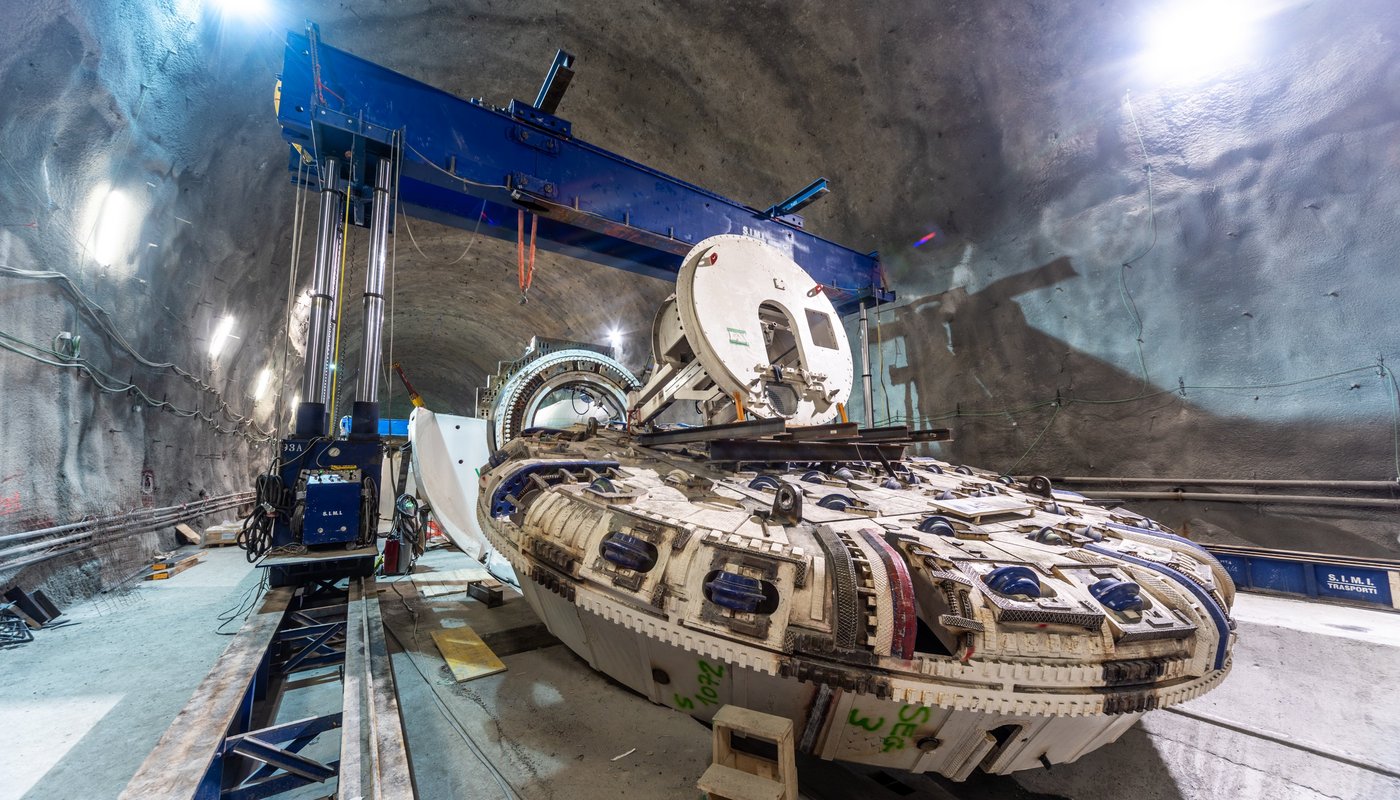
THE TBM IN FIGURES
Cutter head diametre
TBM total length
Driving power (5.710 PS)
TBM total weight
installed by TBM Virginia to form the inner lining
ARRIVAL OF TBM VIRGINIA AT THE BRENNER PASS
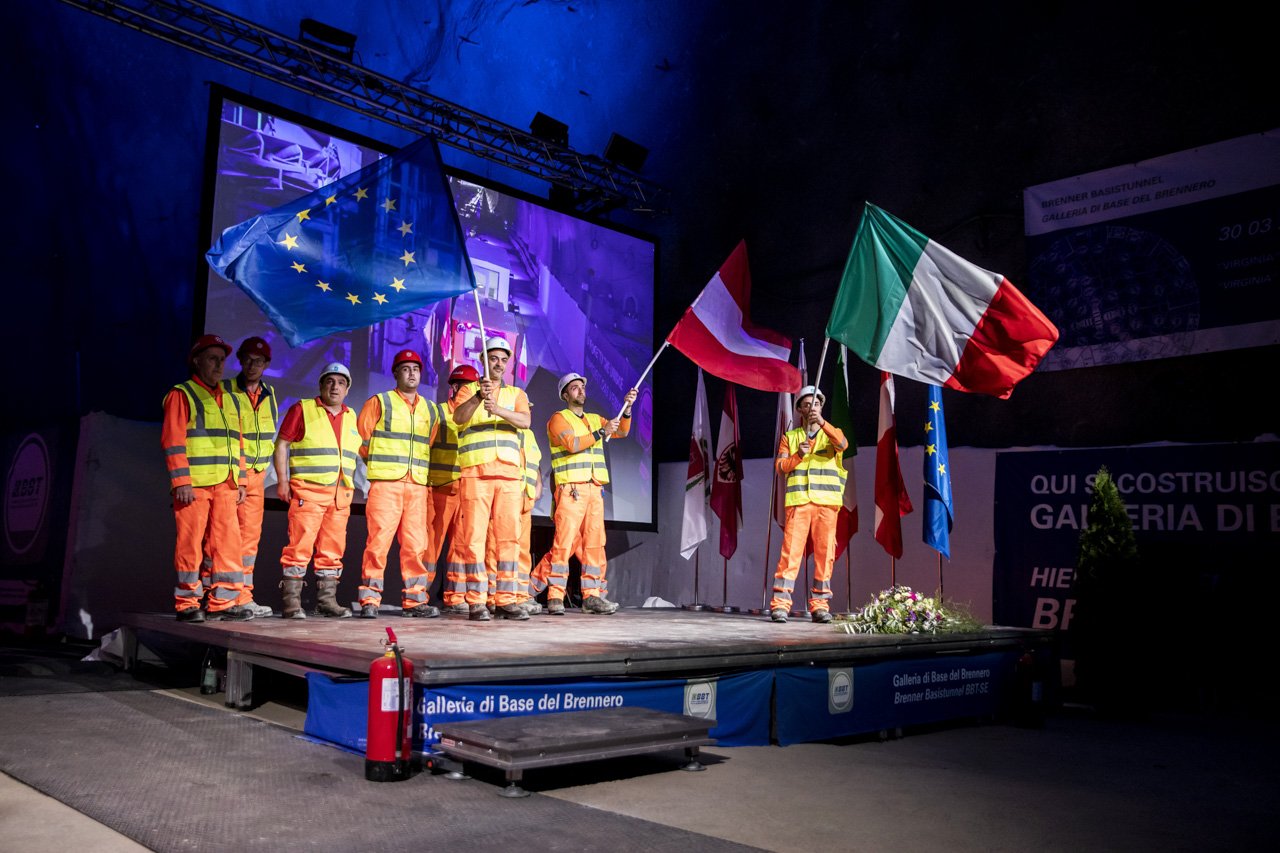
The arrival of TBM Virgina at the Brenner Pass on 30 March 2023 marked a historical milestone in the Mules construction lot.
After covering a distance of more than 14 kilometres, the double-shield TBM reached the state border between Italy and Austria. Following Serena, Virginia was the second tunnel boring machine to complete the journey from Mules to the Brenner Pass - and the first to reach its destination in one of the two main tunnel tubes.
Virginia arrived with a minimal deviation of less than 2 cm in both horizontal and vertical alignment – a remarkable achievement!
GEOLOGY
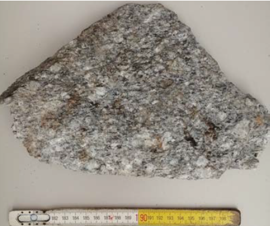
Old Crystalline formations: This strongly foliated, fine-grained rock consists predominantly of quartz, mica and feldspar. It formed from fine-grained marine sediments of Palaeozoic age, which were transformed into mica schist and paragneiss during the formation of the Alps.
The Palaeozoic (also known as the Paleozoic Era or the “Age of Ancient Life”) spans the geological period from approximately 538.8 to around 251.9 million years ago.
Mountain building, or orogeny, refers to the formation of mountain ranges through the deformation of rock masses over geological timescales.
Bündner schists: This strongly foliated, medium- to fine-grained rock consists predominantly of carbonate, quartz and mica. It formed from marine sediments of the Mesozoic Era and was transformed into calcareous schist and, to a lesser extent, calcareous marble during the formation of the Alps. The Mesozoic Era (also known as the “Reptilian Age”) is a geological era that began approximately 252 million years ago and ended around 66 million years ago.
Central gneiss: This slightly foliated rock consists mainly of quartz, feldspar and mica. It formed from intrusive igneous rock (granite or granodiorite) and was transformed mainly into orthogneiss during the formation of the Alps. In geology, “intrusive” refers to rocks or geological structures formed by the intrusion of magma into pre-existing rock.
DISMANTLING
After overcoming some of the hardest and most abrasive rock formations in the entire Alpine region, TBM Virginia was dismantled directly on the construction site.
In geology, the term “abrasive” refers to a material or process that has a grinding, rubbing or wearing effect on rocks and minerals.

DISTINCTIVE FEATURES OF TBM VIRGINIA
During its journey through the Mules construction lot, which began on 22 May 2019, TBM Virginia advanced an average of 10.2 metres per day, reaching a peak of 40.5 metres in a single day on 16 February 2020.
Virginia is considered a “record-breaking tunnel boring machine”. Its performance sets it apart from all other machines with a comparable cutterhead diameter of 10.71 metres. In March 2021, it advanced an impressive 859.5 metres in a single month, while simultaneously installing the inner lining made of tubbing rings.
A double challenge
For Virginia, the challenge was not only to drive the east main tunnel through extremely difficult fault zones. During the drive, more than 65,000 tubbing segments were also installed. The tubbing segments were manufactured at the Hinterrigger plant near the Mules construction site, which operated from 2017 to 2024 to produce the BBT tunnel lining segments. From there, the precast concrete elements were transported by rail directly to TBM Virginia.
As heavy as a Boeing, as powerful as a Ferrari
With a total weight of 2,750 tonnes, Virginia weighed roughly as much as eight fully loaded Boeing 747s. Its drive power of 4,200 kW was equivalent to around 5,700 horsepower—about the combined power of 17 Formula 1 racing cars.