
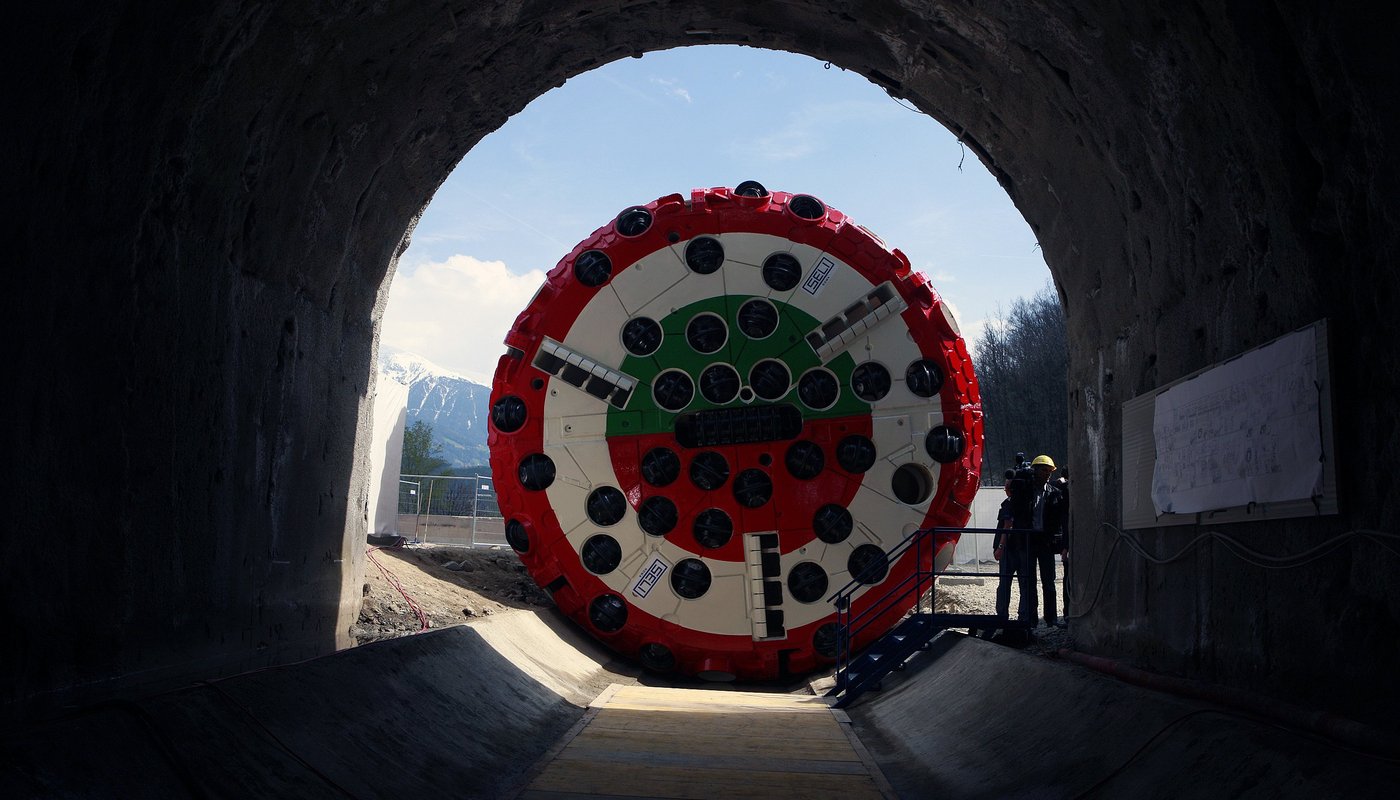
THE TBM IN FIGURES
Cutter head diametre
TBM total length
Driving power (2.665 PS)
TBM total weight
installed by TBM Clio to form the inner lining
BREAKTHROUGH OF TBM CLIO TO THE MULES CONSTRUCTION LOT
The breakthrough of the exploratory tunnel between Aica and Mules took place on 3 November 2010. This breakthrough marked the completion of TBM Clio’s more than 10-kilometre drive northward.
With the completion of just over one fifth of the 57-kilometre-long exploratory tunnel, the first TBM of the Brenner Base Tunnel had reached its goal.
Approximately two and a half years earlier, the tunnel boring machine had been put into operation by a special guest: the then President of the Italian Republic, Giorgio Napolitano.
As the project progressed, two further tunnel boring machines, Günther and Serena, took over the mechanical excavation of the exploratory tunnel after Clio, complementing the conventional drilling and blasting method.


GEOLOGY
Brixner granite: The plutonic rock consists mainly of quartz, feldspar and mica. It was tectonically deformed during mountain building, but is not metamorphic. It belongs to the tectonic unit of the Southern Alps, which forms part of the African continental plate south of the Periadriatic Seam.
Plutonic rocks, also known as intrusive rocks, form deep below the Earth’s surface through the slow cooling and solidification of magma.
Metamorphic rocks are rocks that have been transformed within the Earth’s crust by high pressure or temperatures without melting.

DISMANTLING
After its journey through the challenging Brixen granite and the simultaneous installation of almost 41,000 tubbing segments forming the inner lining of the exploratory tunnel, TBM Clio was dismantled directly on site.


DISTINCTIVE FEATURES OF TBM CLIO
Excavation and inner lining - 40,920 tubbing rings for the tunnel
Clio was the very first TBM ever used for excavation within the tunnel system of the Brenner Base Tunnel. On the Italian side of the project area, it worked its way through the rock almost around the clock in the exploratory tunnel.
The only exception was the daily maintenance work carried out between approximately 7 and 11 a.m. During this time, the machine was stopped to allow the technicians access to the cutterhead. They replaced worn cutting discs, checked the hydraulic circuits, and lubricated the main seals. These tasks could only be carried out while the machine was at a standstill.
In parallel with the tunnel excavation, Clio installed the tunnel inner lining along its nearly 10.5-kilometre route. It consists of a total of 6,820 tubbing rings. Each tubbing ring consists of six segments: five segments forming the ring and one base segment, which forms the lower end and thus the “floor” of the exploratory tunnel. In total, the TBM installed 40,920 precast reinforced concrete elements: 34,100 ring segments and 6,820 base segments.
HOW TBM CLIO GOT ITS NAME
The name “Clio” was chosen in honour of the wife of the then President of the Italian Republic, Giorgio Napolitano, who had travelled to Aica on 28 April 2008 to attend the start-up ceremony of the tunnel boring machine. The first TBM of the BBT was thus named after lawyer Clio Maria Bittoni.